The $30,000 Disruptor - What Two Wars Teach Us About Marketing Myopia
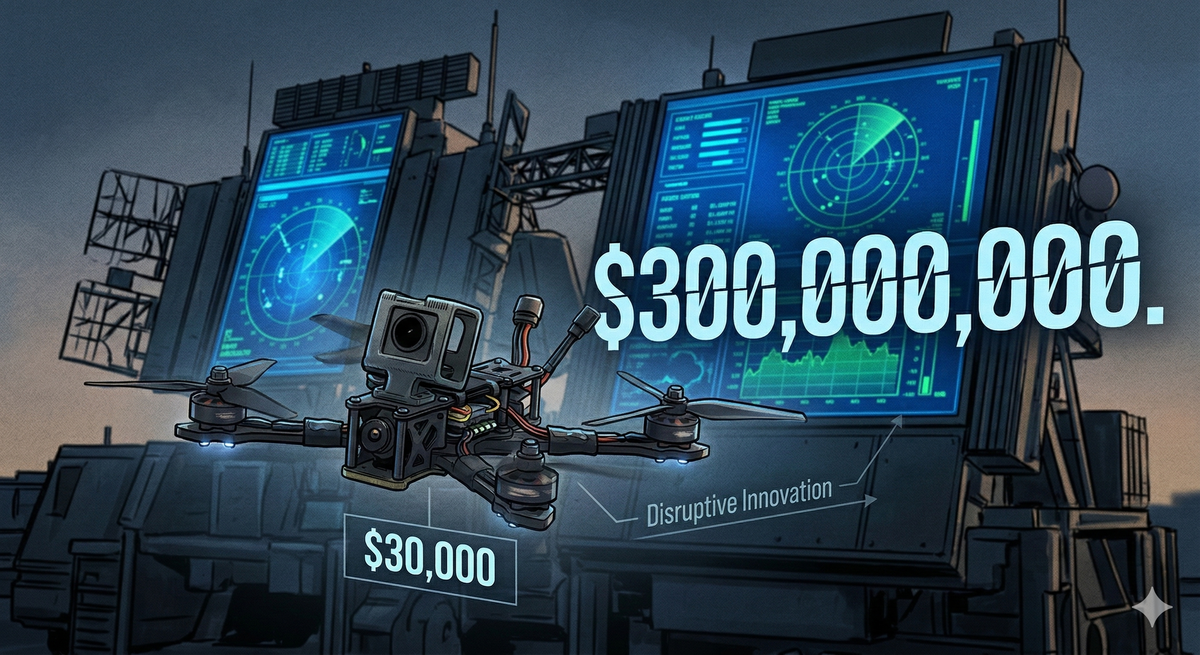
In 2024, a drone, built with commercial off-the-shelf components and costing roughly $30,000, destroyed a $300 million American radar installation in Bahrain. Read that again. A 10,000:1 cost asymmetry. One side lost pocket change. The other side lost a cornerstone of its regional defence architecture.
This wasn’t a fluke. It was a signal.
Across two major conflicts, Russia’s invasion of Ukraine and the ongoing US-Israel military campaign in Iran, the same pattern is playing out. The world’s most powerful, most expensive, most technologically sophisticated militaries are being forced to recalculate. Not because their products failed. But because the definition of what counts as a product changed underneath them.
If you’re a marketer, a strategist, or a business leader, you’ve seen this movie before. You just didn’t expect it to be playing on the battlefield.
When “Good Enough” Eats “Best-in-Class” for Breakfast
Iran’s Shahed-136 drone has earned a telling nickname in defence circles: the poor man’s cruise missile. It is, by any technical standard, unremarkable. About 3.5 metres long, a 2.5-metre wingspan, carrying 30 to 50 kg of explosives, guided by basic GPS. Analysts sometimes describe it with barely concealed condescension.
And yet, it is reshaping the strategic calculus of the world’s most advanced militaries.
Let me walk you through the economics, because the numbers are staggering. A single Shahed costs a few tens of thousands of dollars to build. A single interceptor missile used to shoot it down? Between $3 million and $12 million, depending on the system. The US military’s own low-cost alternative, the LUCAS drone, costs about $35,000, while a Tomahawk cruise missile runs up to $2.5 million. In the current conflict, Iran has launched over 1,450 drone strikes and more than 540 missiles in just the first week. Think about what that means. The mathematics of attrition are brutal: the defender bleeds by winning.
In Ukraine, the story rhymes. Small, cheap FPV drones, some assembled from commercial quadcopter parts and costing a few hundred dollars, are destroying million-dollar tanks. Ukraine’s Bayraktar TB2 drones became legends early in the war not because they were the best technology on the battlefield, but because they were good enough and available in numbers. Russia, in turn, began mass-deploying Iranian-made Shahed drones (rebranded as Geran-2) against Ukrainian infrastructure, forcing Ukraine to expend premium interceptors on cheap incoming threats.
The pattern is identical in both theatres: mass beats precision. Cost beats capability. “Good enough” at scale overwhelms “best-in-class” in limited supply.
Any student of business strategy will recognise this instantly. This is Clayton Christensen’s disruptive innovation thesis, played out in live fire.
The Ghost of Theodore Levitt
In 1960, Theodore Levitt published what would become the most influential article in the history of marketing thought: Marketing Myopia. His argument was deceptively simple and devastatingly powerful.
Industries decline, Levitt argued, not because markets shrink, but because management defines the business too narrowly. The railroads didn’t lose to cars and airlines because demand for transportation fell. They lost because they thought they were in the railroad business, not the transportation business. Hollywood nearly died not because people stopped wanting entertainment, but because the studios saw themselves as being in the movie business rather than the entertainment business.
The core insight is timeless: organisations that define themselves by their product, rather than by the customer need they serve, become vulnerable to disruption from anyone who serves that need differently.
Now look at what’s happening on the battlefield.
The US military-industrial complex has, for decades, defined itself by its products: fifth-generation stealth fighters, aircraft carrier strike groups, precision-guided munitions, satellite-based intelligence networks. These are extraordinary technological achievements. They are also extraordinarily expensive, extraordinarily complex, and extraordinarily slow to develop and deploy. An F-35 fighter jet costs over $80 million. A Ford-class aircraft carrier costs $13 billion. Development cycles run into decades.
The implicit assumption behind all of these products is: We are in the advanced weapons systems business.
But the actual job to be done, the need being served, is far simpler: neutralise threats. Impose costs on adversaries. Control territory.
Iran and Ukraine’s drone operators are not in the advanced weapons systems business. They are in the threat neutralisation business. And in that business, a $30,000 drone that can destroy a $300 million radar is not a crude, inferior product. It is a superior solution to the job at hand.
Levitt, had he been alive today, would have recognised this immediately. The military-industrial incumbents are the railroads of the 21st century. Superbly engineered, operationally excellent, and strategically myopic.
The Adaptability Gap: Why Incumbents Can’t Pivot
Here’s where the story gets really interesting for marketers. Because the incumbents know the disruption is happening. The US military has been talking about the drone threat for years. They’ve studied Ukraine. They’ve reverse-engineered the Shahed and even deployed their own version in combat against Iranian targets. They are not ignorant. They are not complacent.
And yet they cannot pivot.
The reason is structural, not intellectual. The US defence ecosystem, from Lockheed Martin to Raytheon to the Pentagon’s procurement apparatus, is optimised for a specific kind of product: large, complex, expensive, long-cycle. Careers are built around managing billion-dollar programmes. Contracts are structured around decade-long development timelines. Performance metrics reward technical sophistication, not cost-effectiveness. The entire organisational DNA points toward the legacy product line.
If this sounds familiar, it should. This is Kodak knowing about digital cameras in 1975 and spending the next three decades perfecting film. This is Nokia’s engineers demonstrating touchscreen prototypes years before the iPhone, while the organisation remained locked into Symbian. The knowledge exists. The capability exists. What doesn’t exist is the institutional permission to cannibalise the existing business.
In marketing terms, this is the agility gap. The challenger, whether it’s a startup, a D2C brand, or a sanctioned nation-state building drones in dispersed underground facilities, operates with a fundamentally different clock speed. It iterates in weeks, not decades. It tests in the field, not in laboratories. It optimises for cost per outcome, not technical specification. To use the language of lean strategy, the challenger runs a continuous cycle of build-measure-learn while the incumbent is still in the “build” phase of a programme that started fifteen years ago.
Consider this telling detail. Defence analysts observing Iran’s drone campaign have noted that Tehran appears to have incorporated battlefield lessons from Russia’s extensive use of the same drones in Ukraine, adding anti-jamming antennas, electronic warfare-resistant navigation, and new warheads. The product is evolving in real time, informed by live data from a different theatre. That’s not a weapons programme. That’s an agile product development cycle.
The Constraint That Isn’t Firepower
But the inability to pivot is a symptom. The deeper problem is a misdiagnosis of where the constraint actually lies. And this connects to a framework I’ve worked with extensively: Eli Goldratt’s Theory of Constraints.
The conventional assumption is that the constraint in warfare (or in market competition) is capability. The side with better technology, more firepower, more resources wins. But what both conflicts reveal is that the binding constraint has shifted. It is no longer capability. It is cost-per-engagement.
Every interceptor missile fired at a $30,000 drone is a $3 to $12 million resource expended. Every premium asset deployed to counter a swarm of cheap drones is unavailable for other missions. The defender’s throughput, its ability to sustain operations over time, is constrained not by its technology but by the economics of engagement. As one defence analyst put it: the winning defence will be the one that can neutralise targets cheaply without burning premium interceptors. Without cheaper layers, the cost curve favours the attacker.
Marketers live with this problem daily, even if they don’t frame it this way. When a D2C challenger forces an incumbent FMCG brand into a price war, the challenger may “lose” every individual battle on reach and distribution. But it wins the war because the incumbent’s margin structure collapses under the weight of its own cost base. When Jio entered Indian telecom with essentially free data, it wasn’t competing on network quality. It was redefining the constraint. The binding constraint was no longer “who has the best network” but “who can sustain the lowest cost per gigabyte.” The incumbents were optimised for the wrong constraint entirely.
This is precisely what the Shahed drone does to air defence doctrine. It redefines the constraint. And once the constraint shifts, all the incumbent’s accumulated advantages, its technology, its training, its institutional knowledge, become, if not irrelevant, then certainly insufficient.
What Levitt Would Ask You Today
If Theodore Levitt were alive and consulting with defence establishments today, his question would be the same one he posed to railroad executives in 1960:
What business are you actually in?
Are you in the “advanced weapons systems” business? Or are you in the “threat neutralisation” business? Because if you’re in the former, you’ll keep building $80 million fighters and $2.5 million missiles and wondering why a $30,000 drone is eating your lunch. If you’re in the latter, you’ll start asking a very different set of questions. What is the cheapest way to neutralise this threat? What is the fastest development cycle we can sustain? How do we optimise for cost-per-outcome rather than technical specification?
The same question applies to every incumbent in every industry.
If you’re a legacy FMCG company, are you in the “mass-manufactured consumer packaged goods” business, or are you in the “solving daily consumer problems” business? Because a D2C brand with a Shopify store and an Instagram following is solving those problems differently, and at a fundamentally different cost structure.
If you’re a traditional university, are you in the “four-year residential degree” business, or are you in the “career-enabling knowledge” business? Because YouTube, Coursera, and a well-designed six-month bootcamp are serving that need at a fraction of the cost.
If you’re a mainstream media house, are you in the “newspaper” business, or are you in the “trusted information” business?
Levitt’s genius was recognising that the answer to “what business are you in?” is never about your product. It’s about the need your customer hires you to fulfil. When you define yourself by your product, you become myopic. And when you become myopic, you become vulnerable.
The Shahed drone doesn’t care about your product roadmap.
The Uncomfortable Lesson
There’s an uncomfortable truth embedded in these conflicts that business leaders would do well to sit with.
Both Russia and the United States, the world’s most powerful military establishments, entered their respective conflicts expecting a quick, decisive win. Russia expected to take Kyiv in days. The US-Israel coalition expected to decapitate the Iranian regime and force capitulation within weeks. In both cases, the larger power had to recalculate. Not because the adversary was stronger in any conventional sense, but because the adversary was playing a different game. One optimised for endurance, cost-efficiency, and asymmetric disruption rather than overwhelming force.
This is the strategic trap that Levitt warned us about sixty-four years ago. When you define competition on your own terms, terms that favour your existing strengths, you feel invincible. But competition doesn’t care about your terms. It cares about the job to be done. And when someone finds a cheaper, faster, “good enough” way to do that job, all your accumulated advantage becomes expensive overhead.
The $30,000 drone didn’t disrupt a $300 million radar by being better. It disrupted it by redefining what “better” means. And that redefinition is never far away.
Every incumbent, in every industry, should be asking: Where is our $30,000 disruptor? And are we the radar?