The Tragedy of the Commons, One Parking Spot at a Time
I live on a campus. It's one of those privileges you don't fully appreciate until you venture out into the chaos of Indian urban traffic. Behind our gates, people drive with a baseline assumption of mutual consideration. Out there? It's every driver for themselves.
What fascinates me—as someone who studies consumer behavior—isn't just that the driving is bad. It's that the badness follows such a predictable pattern. It's not random chaos. It's systematic dysfunction emerging from individually rational choices.
The Paradox
Consider three common behaviors:
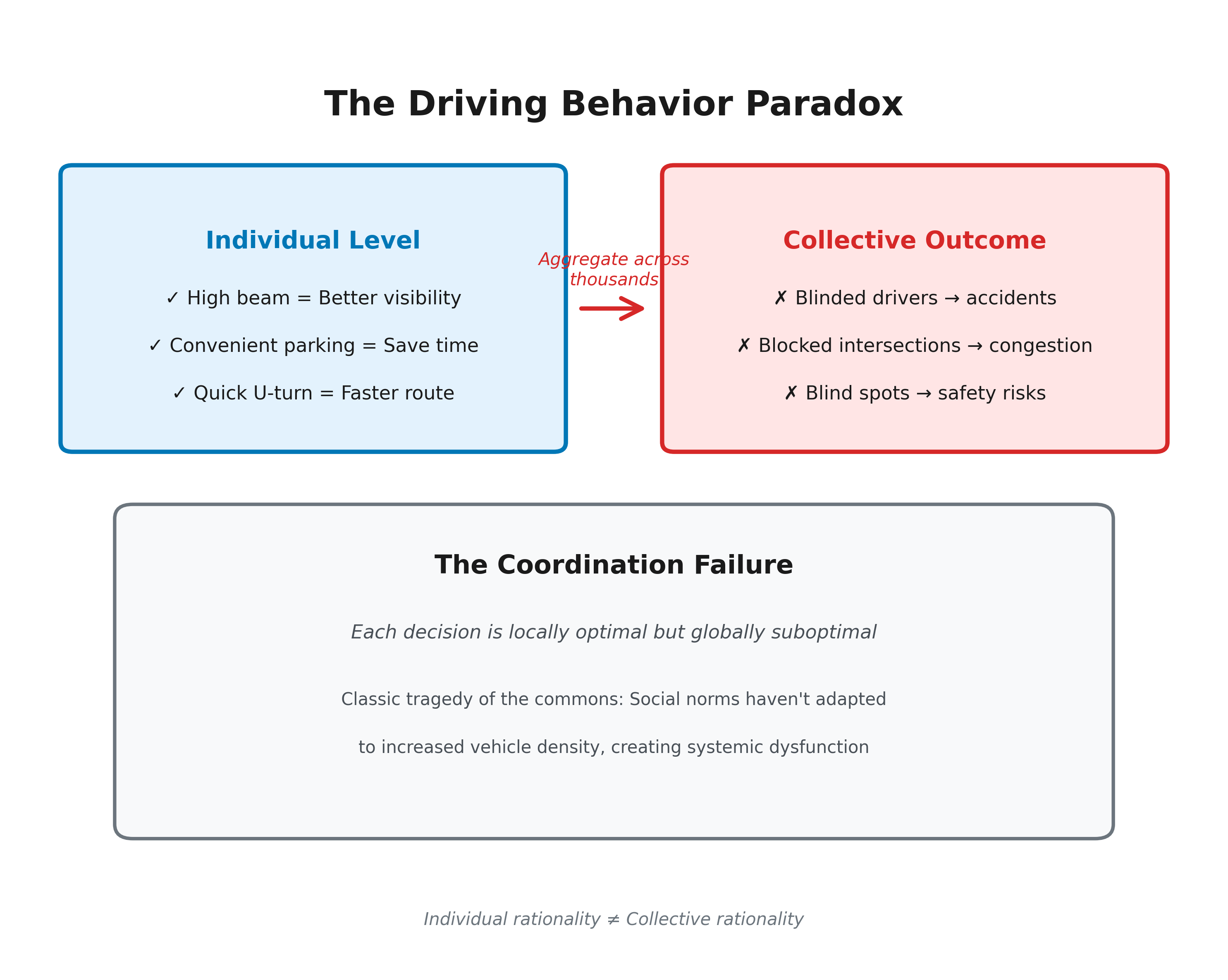
High beams at all times. Why not? Better visibility for me means safer driving for me. The fact that I'm blinding oncoming traffic? Not my problem. They should've worn sunglasses at night.
Parking exactly where U-turns happen. This spot is convenient. It saves me two minutes. Sure, it forces everyone else into elaborate three-point-turns or creates a blind spot that increases accident risk, but I'll only be here "for a minute."
Blocking intersections during traffic jams. If I don't inch forward and claim this space, someone else will. Never mind that I'm now stuck perpendicular to traffic flow, ensuring nobody can move when the light changes.
Each decision makes perfect sense at the individual level. Each driver is optimizing locally. And yet, aggregate these choices across thousands of drivers, and you get gridlock, blinded motorists, and a persistent low-grade danger that everyone just accepts as "normal."
This is a coordination failure. More specifically, it's a tragedy of the commons - the textbook scenario where individual incentives and collective welfare diverge (believe me, we teach these things in class).
Why Social Norms Haven't Caught Up
Here's what makes this interesting: these behaviors probably worked fine 20 years ago. When roads were less crowded, high beams didn't blind as many people. Parking in slightly inconvenient spots didn't cause cascading problems. Road capacity exceeded demand, so individual optimization didn't trigger systemic collapse.
But vehicle density in Indian cities has exploded in recent years. We've motorized faster than our social norms could adapt. The behaviors that were marginally antisocial in 1995 are actively dangerous in 2026.
And yet, enforcement is sparse. There's no peer pressure mechanism - you can't shame an anonymous driver you'll never see again. The feedback loops that usually create and reinforce social norms simply don't exist in high-velocity urban traffic.
So we're stuck in a bad equilibrium. Everyone knows the system is broken. Everyone complains about "other drivers." But everyone also contributes to the problem because unilateral cooperation is expensive and unrewarded.
The Game Theory
Think about it as a multiplayer game. If everyone cooperates (no high beams, considerate parking, patient intersection behavior), everyone wins. But:
- Cooperation costs you something: time, convenience, visibility
- Defection benefits you directly: you get there faster, you get the good parking spot, you can see better
- You can't punish defectors effectively
- You can't even identify repeat defectors
So the Nash equilibrium is universal defection. Not because Indian drivers are uniquely terrible - this would happen anywhere with similar conditions. It's just that we're further along the motorization curve than our coordination mechanisms can handle.
What Might Actually Work?
The standard policy responses - more traffic police, heavier fines, awareness campaigns - assume the problem is information or enforcement. I'm skeptical. Drivers know they shouldn't use high beams. They just don't care because the personal cost is zero.
So what might shift the equilibrium?
1. Design away the bad behavior
Infrastructure that makes antisocial behavior physically difficult. Speed bumps that force slowing. Parking designs that eliminate blocking options. Road geometry that naturally prevents dangerous maneuvers. This is the "nudge" approach - change the choice architecture.
2. Create real-time feedback
Several countries use driver scoring systems that gamify good behavior. Your insurance rates, parking privileges, or even congestion pricing could depend on a publicly visible "driving score" that factors in complaints, camera violations, etc. Suddenly there's reputation at stake.
3. Price the externalities
If blocking an intersection cost you ₹500 automatically (via camera + digital payment+AI surveillance), you'd think twice. If high beam usage in city limits triggered instant fines, the behaviour would plummet. The trick is making the enforcement automatic and unavoidable.
4. Leverage group identity
Some places use vehicle marking to create accountability - "How's my driving? Call..." (this is the case with school buses and ambulances in TN). This works because it makes drivers representatives of their company/group. Could we create neighborhood-based driving identity? Harder in anonymous cities, but possible.
Or Maybe This Is Just Growing Pains?
There's another possibility: we're simply in a painful transition period. Every rapidly motorizing society goes through this. Eventually - maybe after enough accidents, enough congestion costs, enough public outrage - the norms shift. Seat belts weren't universal in the US until the 1980s. Drunk driving was socially acceptable until it wasn't.
Maybe Indian urban driving will self-correct as:
- The current generation ages out and is replaced by drivers raised with different norms
- Smart city infrastructure makes bad behavior harder
- Electric vehicles with advanced safety features become standard
- Congestion becomes so unbearable that collective action becomes politically unavoidable
But that's cold comfort for those of us navigating this mess now.
Back to Campus
I realize how fortunate I am. Campus life shields me from most of this. Our internal roads have low traffic, familiar faces, and a baseline expectation of community consideration. When I do venture out, I'm reminded viscerally of what coordination failure looks like at scale.
It also makes me think about other domains where we're seeing similar patterns. Digital platforms with engagement-optimized algorithms creating information chaos. Housing markets where individual speculation prevents collective affordability. Climate change as the ultimate tragedy of the commons.
The driving problem is just unusually visible. You can literally see the dysfunction in real-time, at every intersection, every evening.
The Question
What fascinates me most is the equilibrium trap. Everyone hates the current state. Everyone would benefit from coordination. And yet we can't get there from here through individual choice alone.
This is where institutions matter - governments, enforcement systems, social norms, infrastructure design. But building those institutions requires collective action, which is precisely what coordination failures make difficult.
So we're stuck discussing whether it's enforcement or education or infrastructure, while continuing to blind each other with high beams.
Maybe that's the real paradox. We're sophisticated enough to analyze the problem. Just not coordinated enough to solve it.
Have you observed similar coordination failures in other contexts? What mechanisms have you seen actually shift people out of bad equilibria? I'd genuinely love to hear thoughts—this is one where I don't have confident answers.