
The Opposite of a Shortcut
What a room of mostly banking executives reminded me about experience, curiosity, and building things that matter
Most of my teaching has been with postgraduate students. They are bright and ambitious and very young — and many of them, if I am honest, have quietly learned to treat AI as a way around the work rather than through it. The tool becomes a shortcut: a way to arrive at the answer without ever passing through the struggle that would have taught them something. There was a stretch when students took to asking ChatGPT to boil a business case down to a hundred words, skimmed the summary, and walked into class loaded with false confidence. I understand the temptation — but I’ll admit, it worries me.
So I will admit I did not quite expect what happened in a course I taught on what the internet has started to call vibe coding. The cohort was senior banking executives — most on the far side of forty, none of them programmers. The brief was deliberately strange: build a real, working web application, but don’t write a single line of the code yourself. Instead, direct an AI to write it for you — describe the problem in plain English, shape the product, review what comes back, and push until it is right. Less an engineer than a creative director.
What I watched was the opposite of a shortcut. It was, in the most literal sense of the word, creation — people bringing into being things that had not existed before, using the machine not to skip the thinking but to skip only the typing. After several years of watching the young reach for AI to avoid learning, it was a genuine breath of fresh air. I wanted to focus this piece of teasing out the differences that I felt as a teacher, and the reflections I had when going through this exercise as a teacher.
They already knew what was worth building.
This was the heart of the difference. My younger students often have to invent a problem before they can solve one; they reach for whatever is fashionable and build a clever answer to a question nobody asked. The executives had no such trouble. They had spent decades inside real problems, and so they built for needs they had actually felt — a tool to stop a freelancer from undercharging, a way to see a whole household’s finances on one screen, an honest audit of the slow leak of forgotten subscriptions, a survival guide for a career in the age of the very technology they were using.
They didn’t need to be taught what mattered. They had lived it. The assignment simply handed them an instrument capable of building the thing they had been carrying around in their heads for years.
The experience showed in the little things.
You could see the decades of judgment not in the grand architecture but in the small refinements — the corrections only someone who had done the work would think to make.
One of them refused to let the app show money the Western way. Where the model kept producing “₹150,000,” he insisted on “₹1,50,000” — the lakhs his users actually read — and had to push back against the model’s defaults again and again to get it. A tiny thing. Also the entire difference between a tool that feels foreign and one that feels like home.
Another pre-loaded his sandbox with believable numbers — a realistic salary, a realistic home loan — so that the instant you opened it, it was already doing something useful, instead of greeting you with a wall of empty boxes. He knew, the way an experienced product person knows in their bones, that a blank screen is where most tools quietly lose you.
One caught the AI cheerfully recommending you cancel a gym membership you used eight times a month — because it had applied a cost-per-hour logic to a category where hours were simply the wrong yardstick. The code was correct. The judgment was not, and he could see it at a glance.
Another noticed his tool handing out gloomy verdicts even to people who had scored well, and understood that the fix was not in the code at all — it was in knowing how a real human being reads a number about their own future.
One had to teach the model that “equity,” in his table, meant direct stocks as distinct from mutual funds — a distinction every banker carries instinctively and the machine had blurred. Another fed his quality dashboard the real vocabulary of his lab, the compliance terms an auditor would actually recognise, until it stopped drifting toward generic charts. One simply could not abide that focus timers quietly lie when you switch browser tabs, and kept refining until his stayed honest to the clock.
None of these are big features. They are the fingerprints of experience. The AI supplied fluency; the humans supplied the thousand small judgments that separate something that looks right from something that is right. As one of them put it, the most important skill he developed was learning to slow down and check — to interrogate the polished result rather than accept it.
What stayed with me
When the projects were done, four things stayed with me.
They wanted to make the world a little better — and now they could. Every one of these tools was, underneath, an attempt to mend some small corner of life: to help a freelancer charge fairly, to help a family understand its money, to help an anxious professional face what is coming. For years, people like this could only describe the thing they wished existed and then wait for someone else to build it. This time they built it themselves.
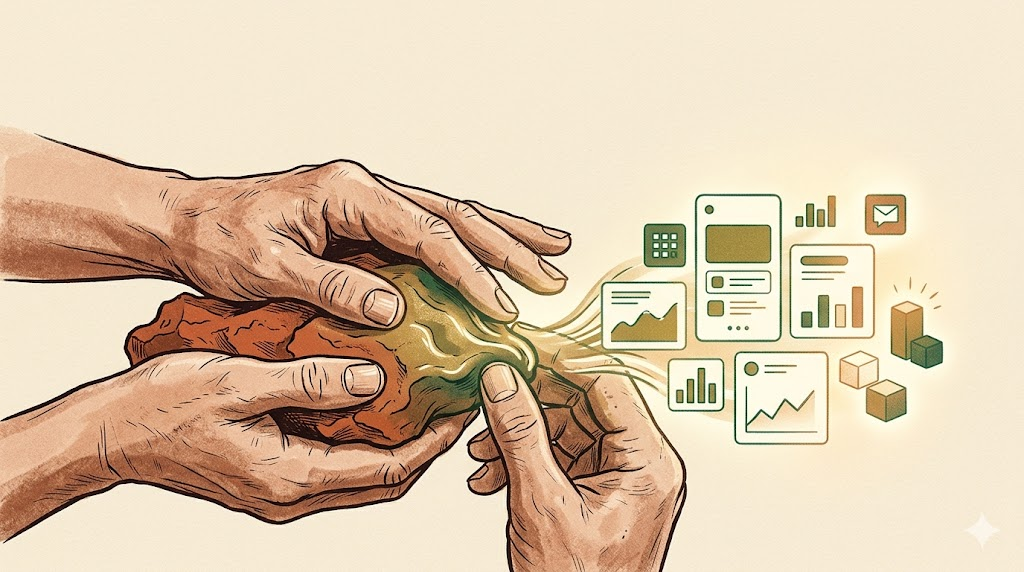
They became curious again. Somewhere on the long climb up a career, the play tends to drain out of work. What I saw here was its return — accomplished adults turning an idea over in their hands, squashing it and reshaping it and seeing what else it might become, exactly the way a child plays with a lump of play dough. There was real delight in the room. I had almost forgotten what that looks like.
They brought their business acumen to bear. They didn’t just build; they weighed. What is worth measuring. What a user will actually do. Where simplicity beats sophistication. More than one of them had to talk the AI out of features — logins, databases, dashboards stacked on dashboards — because their instinct for what a product truly needs was sharper than the machine’s enthusiasm for what it could add.
And their experience turned out to be the asset, not the obstacle. There is a lazy story we tell about technology: that it belongs to the young, that the years which give you grey hair also leave you behind. This cohort put the lie to it. The very experience that supposedly makes someone “too set in their ways to learn to code” was exactly what let them aim a powerful new instrument at problems they understood better than anyone in the building. They did not need to become programmers. They needed only to stay themselves.
So if there is one thing for you to take from all this, it is that the tool is the same for everyone — what differs is what you bring to it. AI will write code for anyone, but it rewards only the person who knows what is worth building and can sense when the answer is quietly wrong. Used to dodge the thinking, it produces confident nonsense — the false confidence I watch my youngest students walk in with. Used to extend thinking you have already done, it produces something real. That judgment is not a young person’s gift or an old person’s; it is an earned one. So if you have spent years building genuine expertise in some corner of the world, and were told somewhere along the way that the technology had passed you by — it hasn’t. It has been waiting for you to pick it up.
Every one of these projects began as a single sentence from someone who knew precisely what they wanted to see in the world. I cannot wait to find out what they build next.
Written reflecting on the work and the critical reflection reports of the AI course cohort, PGDM Tech (IIM Sirmaur × NSE Academy), 2025.