
The Iron Throne and Fort St. George: Legitimacy Is Not Liquidity
Two rulers took charge this summer with the same problem. Neither of them campaigned on it.
Since 22 June, my Mondays have begun at an hour I would struggle to defend in a faculty meeting. HBO drops House of the Dragon at 6.30 am IST, and I have made my peace with the fact that this is now a standing appointment in my calendar.
What I did not expect was that the show would start doing the work of my agency theory lecture for me.
The Dragon's Burden
The premise, briefly. King Viserys Targaryen names his daughter Rhaenyra as heir, partly on the strength of a prophecy about a threat from the North. He then marries Alicent Hightower, of the realm's second most powerful house, and produces sons who want the same chair. The result is a civil war fought with dragons, which is roughly what happens when succession is governed by a verbal promise rather than an enforceable contract.
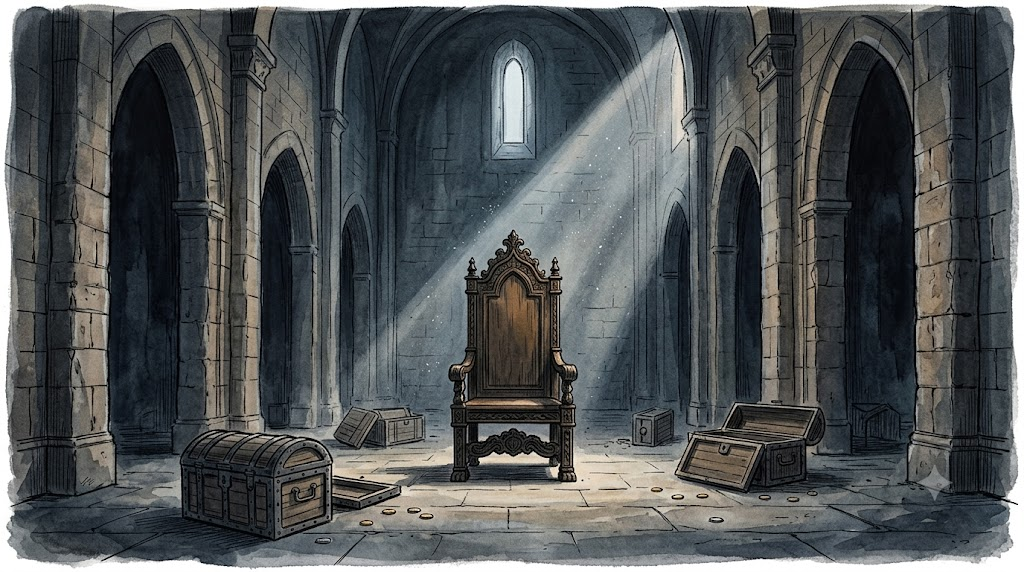
By the second episode of this season, Rhaenyra has it. King's Landing is taken, Otto Hightower is executed, and she is sitting on the Iron Throne.
The third episode is titled “Rhaenyra Triumphant”, and the title is doing a great deal of ironic labour. Almost the entire episode takes place inside the Red Keep, and it is essentially a ninety-minute demonstration that a conquest and an operation are different animals:
- The treasury is empty. The gold is gone. There is barely enough to pay the soldiers, let alone stage a coronation. The Grand Maester does not know where it went, and neither does anyone else she can ask.
- The city is hungry. She ends the episode handing out food outside the Grand Sept, which is a coronation of a rather different kind.
- Nobody quite reports to her. A hostile High Septon, a wary Corlys Velaryon, new dragonriders of uncertain loyalty, and Alicent's sons somewhere at large. Every conversation is a negotiation.
She won the war and inherited a working capital problem.
Fort St. George
While Westeros was going through this, a structurally identical drama had already played out about 2,000 kilometres south of my desk. And in many ways, this crisis is a lot more interesting to follow (which I do during the evening).
On 4 May 2026, Tamilaga Vettri Kazhagam won 108 of 234 seats in its first-ever election, ending fifty-nine years of Dravidian duopoly on a record 85.1% turnout. On 10 May, C. Joseph Vijay was sworn in as the twenty-second Chief Minister of Tamil Nadu.
It is a genuinely remarkable political achievement. It is also, from where I sit, a case study in the difference between winning a mandate and holding a position.
The arithmetic. The majority mark is 118. TVK has 108, and 107 once Vijay vacated Trichy East to retain Perambur. The gap is closed by the Congress (5), CPI (2), CPI(M) (2), VCK (2) and IUML (2). TVK contested 233 of 234 seats alone — that was the strategy, and it very nearly worked outright. The consequence is that the coalition was assembled after the votes were counted.
The balance sheet. The interim budget his predecessors tabled in February projects outstanding debt of ₹10.71 lakh crore by March 2027 — about 26.35% of GSDP. The state plans to borrow ₹1.79 lakh crore in 2026-27 and repay ₹60,413 crore of it. Revenue deficit: ₹48,696 crore. Fiscal deficit pencilled in at 3% of GSDP, which is the ceiling, not a target.
And here is the part that complicates the easy partisan reading: a substantial share of that constraint was not set in Chennai. Tamil Nadu's share of central tax devolution has fallen from 7.9% at the Ninth Finance Commission to 4.079% — a cumulative shortfall the state pegs at ₹3.17 lakh crore, roughly a third of its outstanding debt. Under the Sixteenth Finance Commission, Kerala got a 23.74% increase and Karnataka 13.27%. Tamil Nadu got 0.44%.
Whatever you think of the previous government, the new one did not inherit a clean sheet, and it cannot borrow its way out.
What the theory actually says
Two frameworks earn their keep here, and they are the two I keep returning to in class.
First, the constraint. Goldratt's argument in the Theory of Constraints is that every system has exactly one binding constraint at any time, and that improvements anywhere else are cosmetic. The organisational failure mode is not laziness — it is energetic optimisation of the wrong node. Rhaenyra's constraint is cash. Vijay's constraint is cash. Every pressure on both of them — appease this lord, announce that scheme, stage the coronation, deliver the manifesto — is a pressure to spend attention and money at a non-constraint. The five-year test for either of them is not whether they do many things. It is whether they identify the one thing and subordinate everything else to it.
Second, the agency problem — and specifically, when the contract gets written. This is the piece I think most commentary misses.
A pre-poll alliance is negotiated ex ante. Partners campaign together, make relationship-specific investments, share a manifesto, and bargain before anyone knows what a seat is worth. A post-poll alliance is negotiated at the precise moment the principal's costs are fully sunk and irreversible. Thirteen MLAs holding the difference between government and opposition do not have 11% of the bargaining power that their seat share implies. They have something much closer to a veto, and both sides know it.
Williamson, if he were alive today, would call this a hold-up problem. Any of us who has managed a distribution channel would call it Tuesday. It is the same structure as a manufacturer who lets a single distributor accumulate 40% of secondary sales and then tries to renegotiate margins — the leverage sits with whoever can walk away cheaply, and it is never the one who has already built the factory.
Rhaenyra's version of this is almost too neat. She took King's Landing through a bargain struck with Alicent before she held the city. Now she holds it, cannot verify what Alicent actually delivered, and accuses her of treachery — at which point Alicent has to remind her that she kept every term. That is not a character flaw. That is what happens when performance is unobservable and the contract has already executed.
The optics problem is a measurement problem
The episode's most discussed scene is a small one: shortly before her first public appearance as queen, Rhaenyra discovers she has her period.
It would be easy to read this as a moment of vulnerability, and it is. But the sharper reading is about signals. Her enemies do not need this fact to be informative about her capacity to rule. They only need it to be observable. In any market where quality is hard to verify — a throne room, a hiring panel, a promotion committee — evaluators substitute what they can see for what they care about. The proxy wins not because it is diagnostic but because it is cheap.
This is not a Westerosi problem. It is the same mechanism that lets an interview panel weight an accent, a college tier, or a candidate's willingness to speak first over anything resembling evidence. Rhaenyra's fear is not that her body signifies weakness. It is that it is legible, and that legibility is enough.
The transfer
If you have ever taken over a territory, a P&L, a division, or a function that someone else ran badly, you already know this shape:
- The mandate that got you the job describes a destination. The balance sheet describes your speed limit. They are set by different people.
- The coalition you assembled to get in is not the coalition you need to govern with, and renegotiating it is most expensive exactly when you most need it.
- Your predecessors' commitments are now your liabilities, and the person who could explain them has left.
Winning is a campaign. It is loud, finite, and measurable. Governing is an operation — quiet, unbounded, and evaluated on things nobody voted for.
Rhaenyra has three more episodes this season to learn it. Tamil Nadu's first full TVK budget goes to the Assembly in the first week of August. That document, not the election result, is the real first read on this government: a manifesto written against a 3% fiscal deficit ceiling is where campaign promises meet the constraint, in public, with numbers attached.
Both seats were won in a season. Both will be judged over five years.