
Drona’s Non-Compete: A Management Audit of the Ekalavya Myth
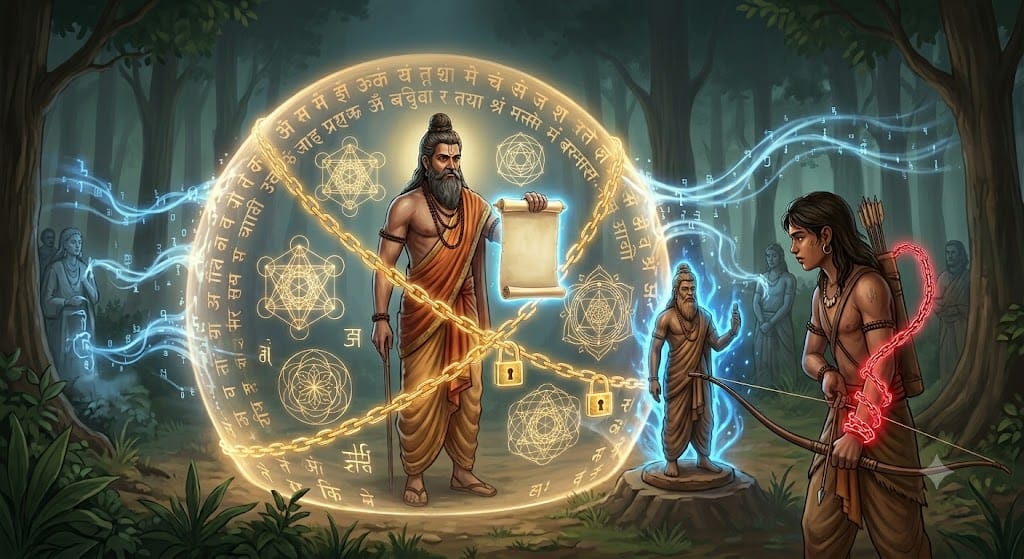
Many years ago, when I first encountered the story of Ekalavya, my immediate reaction was visceral: How could a teacher do this to any student?
As an educator, it was really hard for me to believe that a Guru would deliberately place such a burden on a dedicated student. Usually, the story brushes this off as Drona’s blatant favoritism for Arjuna. As the story goes, he wanted to ensure that no one could ever challenge him. This is also what we read as children in the Amar Chitra Katha. Arjuna goes running back to Drona after seeing Ekalavya accomplish incredible archery feats and reminds him that Drona had promised he would be the most accomplished archer in the world with no rival. What happens after this is a direct consequence.
Recently, however, I came across a fascinating reinterpretation of this story by scholar Dushyanth Sridhar that feels far more grounded in reality. It shifts the narrative away from a teacher’s petty bias and places it squarely in the realm of strategic resource management and intellectual property. (Sorry for making this about management, but I have a point to make here).
Drona’s Institutional Mandate and the "Non-Compete"
To understand this, we have to look at Drona not just as a revered guru, but as an institutional asset.
Following a bitter feud with Drupada, the King of Panchala, Drona aligns himself with the Kuru dynasty. They employ him for his immense military and pedagogical capabilities. However, this employment comes with stringent conditions from Bhishma himself. In modern corporate terms, Drona operates under a strict non-disclosure and exclusivity agreement with Bhishma and the Kuru state.
Therefore, Drona is contractually bound to teach only the Kuru princes, serving as a highly restricted, critical resource for the dynasty. His curriculum is the kingdom's proprietary advantage (much like our intellectual work as professors is often the claim of the institute that we work for in modern times).
Viewed in this manner, Drona demanding Ekalavya’s right thumb is the brutal enforcement of a non-compete clause. Ekalavya hailed from the Nishada clan, well outside the Kuru dominion. Drona simply could not risk arming a potential rival from an opposing faction without violating his foundational contract with his employers. According to this interpretation, the conditions placed upon Drona made him act in the way he did. It was not favoritism or caste-related.
The Student’s Perspective
Now, let’s look at the student’s perspective for a moment.
Ekalavya possessed a profound ability to absorb and apply knowledge entirely on his own. He built a clay statue of Drona and made it his teacher. In this respect, he is not exactly working as an enemy operative. He’s just a curious kid wanting to learn—much like many of us learning methods and theories from YouTube videos of amazing professors.
But when discovered, it became very clear through Ekalavya’s mastery that the Kurus' proprietary advantage was highly vulnerable. If an outsider could achieve this level of elite skill for free, simply by observing, the institutional monopoly was effectively broken.
(I do wonder why the Kuru princes, who had more immersive classroom experiences, did not quite measure up to this young boy.)
The Pedagogical Tragedy
This brings us to the philosophical heart of the story. The demand for Ekalavya's thumb is the mythological equivalent of a violent DMCA takedown or a brutal cease-and-desist order.
It highlights the reality we all live in: whoever funds the R&D demands to own and tightly control the output. This is now the case with medicine, AI, drones, and even search algorithms. Elite institutions fiercely guard their curriculums behind massive tuition paywalls, while independent, driven learners scrape the internet to build the exact same skillsets.
Today, however, many titans of the industry are actively looking for these modern Ekalavyas and hiring them to build the next big thing. There is no Drona to demand a finger. What exactly changed?
My answer here is competition. The only reason the NDA existed in the first place was because archery was such a closely guarded secret. That is no longer the case. With multiple acharyas reaching out to students and spreading knowledge, the student finally has a choice.
The Glaring Plot Hole: A Systemic Failure
While this perspective explains Drona’s motivations as a contracted professional, it leaves us with a glaring question about the Kuru administration. What exactly was the Kuru military doing?
If this training ground was essentially a highly classified corporate R&D facility for the kingdom's future leaders, how was Ekalavya able to observe Drona’s proprietary training closely enough, and for long enough, to master it?
The fact that an unrecognized outsider from a rival clan could sit in the woods, observe their techniques, and weaponize them without a single security alarm going off is a catastrophic oversight. It is enough to ask for Bhishma’s or Dhritarashtra’s resignation.
Perhaps Ekalavya didn't just expose a flaw in Drona's contract. He exposed a massive, systemic vulnerability in the Kuru firewall—and for that reason, he had to be neutralized. As with any catastrophic security breach, the leadership immediately controlled the narrative. The enduring tale of a teacher’s overwhelming devotion to his favorite student wasn't a tragedy; it was simply excellent PR, spun by those in power to cover up a monumental administrative failure.